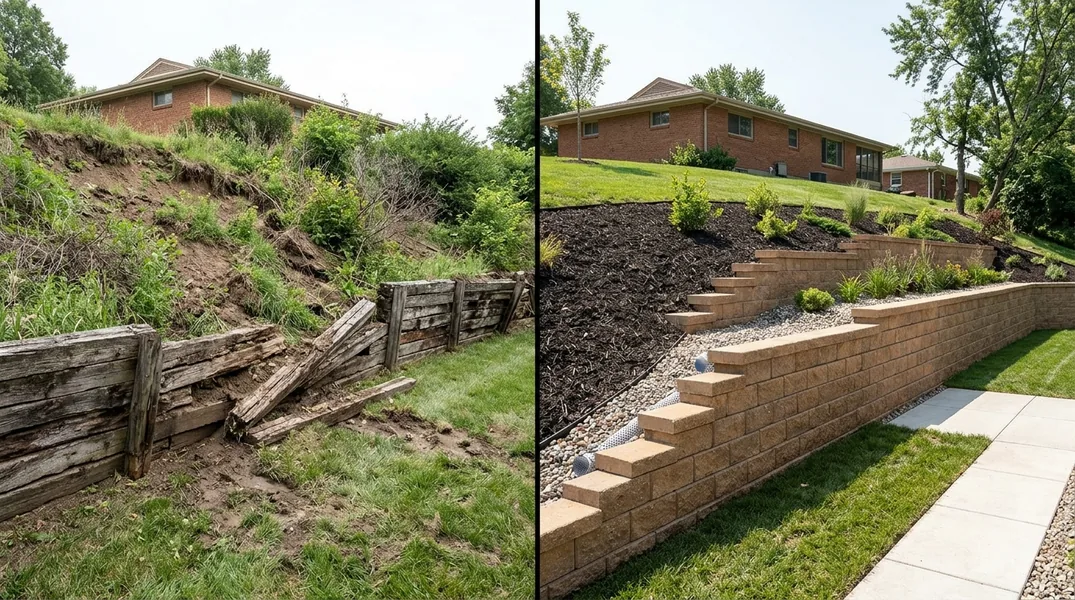
Why Retaining Walls Lean in Omaha's Soil and Weather
A leaning retaining wall is one of the most common calls we get from homeowners across the metro. The cause is usually not mysterious. Omaha sits on expansive clay soils that swell when wet and shrink when dry, and that constant movement puts steady pressure on any retaining structure. Add freeze and thaw cycles in winter, plus heavy spring rain, and even a well-built wall can start to shift over time.
The lean itself is a symptom, not the disease. Behind the wall, hydrostatic pressure builds when water cannot drain away quickly enough. If the drainage system is clogged or was never installed correctly, water saturates the backfill and pushes the wall forward. Poor compaction during the original build, roots from nearby trees, or a wall that was simply undersized for the load can all contribute. Understanding the root cause is the first step in deciding whether you are facing a leaning retaining wall repair or a full retaining wall replacement.
Signs Your Leaning Wall Can Still Be Repaired
Not every lean means the wall is finished. If the movement is minor, recent, and the wall itself is structurally sound, a targeted repair is often the smartest and most affordable path. Look for a lean of just a few inches, blocks or panels that are still tightly fitted, and no significant cracking through the wall's face. In these cases, the problem is often drainage or soil pressure rather than a failed structure.
Professional Retaining Wall Repair might involve clearing and rebuilding the drainage system, adding proper backfill and compaction, installing helical anchors or tiebacks to pull the wall back into position, and repointing or patching minor surface damage. If your wall is made of poured concrete and the issue is isolated, Concrete Retaining Walls can sometimes be stabilized with crack injection and reinforcement. A thorough on-site inspection is the only way to know for sure, and a free estimate gives you a clear answer without guesswork.
When Replacement Is the Safer Choice
Some walls are beyond economical repair. If the wall has rotated significantly, if the blocks are separating or bulging, or if you can see soil pushing through gaps, the structure has likely lost its ability to hold back the earth. Wide or stair-stepped cracks, especially ones that run through the entire wall, are a serious warning sign. So is a wall that has already been repaired once and is leaning again.
In these situations, patching the surface only delays the inevitable and can even be unsafe. A full Retaining Wall Replacement lets you address the real problem: the drainage, the footing, and the engineering behind the wall. Modern systems, including properly engineered segmental block and reinforced concrete walls, are designed to handle Omaha's soil conditions far better than many older walls. Replacement is a bigger investment upfront, but it protects your landscape, your home's foundation, and your safety for decades.
Retaining Wall Crack Repair: What Those Cracks Are Telling You
Cracks are the language your wall uses to communicate. Hairline cracks in a concrete wall may be cosmetic and easy to seal, but wider cracks, horizontal cracks, or cracks that follow a zigzag pattern through block joints usually point to movement or pressure that needs professional attention. A crack that is growing wider over time is a red flag that should not be ignored.
Retaining wall crack repair can range from simple epoxy injection to rebuilding a section of the wall, depending on the cause. The key is to diagnose why the crack formed before sealing it. If water is the culprit, sealing the crack without fixing drainage just moves the problem somewhere else. A qualified contractor will examine the wall, the soil, and the drainage together, then recommend the least invasive repair that will actually last. For homeowners in Omaha and nearby communities like Papillion, La Vista, and Ralston, that local experience with clay soils matters.
Repair or Replace Near Me: How to Decide and Who to Call
So how do you choose? Start with the age of the wall and its history. A wall under ten years old with a slight lean is often a good repair candidate. A wall over 25 years old with significant movement is usually a replacement candidate. Consider the height and load as well: taller walls holding back driveways or upper yards carry more risk, and a failed wall can cause serious property damage. Finally, weigh the cost. A repair that costs half as much as a new wall but only lasts a few years is rarely the better deal.
Because every wall is different, the most reliable approach is a professional inspection. Omaha Retaining Wall provides Retaining Wall Installation, repair, and replacement throughout the area, and we will give you an honest assessment of which option makes sense for your property. Call (402) 281-9526 to schedule a free estimate, and we will walk you through your options, explain the pricing, and help you protect your landscape before a small lean becomes a big problem.
Looking for a professional retaining wall contractor in Omaha? Omaha Retaining Wall responds fast for all your retaining wall needs.
Get a Free QuoteOur services: Retaining Wall Installation · Retaining Wall Repair · Retaining Wall Replacement