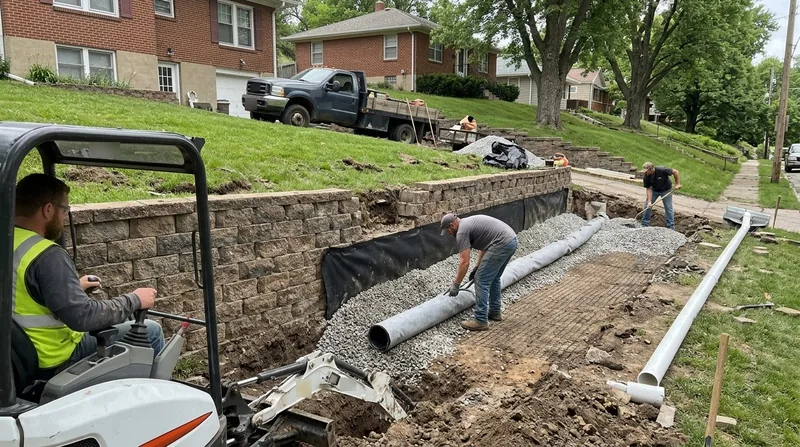




Retaining Wall Drainage in Omaha: Keep Water From Taking Your Wall Down
Omaha sits on wind-blown loess hills above the Missouri River, and that geology decides how your retaining wall lives or dies. The loess slumps when it gets saturated, the clay till underneath swells, and hard freeze-thaw cycles push frost heave into every footing. Add the spring thunderstorms that dump two inches in an hour, and you have the number one reason walls fail here: trapped water. Retaining Wall Drainage in Omaha is the work that relieves hydrostatic pressure before it leans your wall, cracks your block, or dumps a timber wall into the driveway. We build French drains, weep holes, gravel backfill, and waterproofing designed for local soil, not a generic spec sheet. If you are already seeing movement, start with retaining wall repair in Omaha and we will tell you whether drainage can save the structure or whether it needs replacement.
Why Drainage Is the Difference Between a 10-Year Wall and a 50-Year Wall in Omaha
Water is the failure mode that dominates in this city, and the housing stock shows it. Walk the alleys in Dundee and Field Club and you will find limestone and fieldstone walls bulging at the base. Head west to Millard and Benson and the segmental block walls behind walkout basements show the same story: saturated loess pushing from behind with nowhere to go. Poured concrete and CMU walls along driveways in midtown crack at the corners when the clay till swells.
- Loess loses strength fast when saturated, so a wall with no drain sees pressure climb every spring storm.
- Clay till swells against the back of the wall and does not drain on its own.
- Freeze-thaw cycles in January and February push frost heave into footings and lift block courses.
- Timber and railroad tie walls rot from the back face first because moisture never leaves the soil.
Every one of those failures starts with water that could have been routed out through a proper drain and gravel envelope. We see walls in Florence and along the north Omaha bluffs where a $600 drain would have saved a $12,000 wall.
Key info: A segmental block wall in Papillion that was leaning 2 inches after four years had no gravel backfill and no weep holes. Weep holes alone would have relieved most of the pressure. We installed a French drain, re-set the top three courses, and the wall has held straight through three spring seasons.
For the engineering side of why this matters, the City of Omaha Planning Department reviews retaining wall permits and drainage details for walls above the local threshold.
How We Build Drainage That Works in Omaha Soil
We do not guess at drainage. We read the slope, the soil, and the wall type, then build a system that moves water out and away. On a loess slope in Bennington or Valley, that means a perforated pipe at the footing, washed gravel wrapped in filter fabric, and a daylight outlet that actually drains. On a concrete wall in Ralston, it means weep holes at the right spacing and a waterproof membrane on the back face. Every job follows the same sequence so nothing gets skipped.
- We inspect the wall, the slope above it, and the outlet points where water can legally go.
- We excavate behind the wall to expose the backfill and the footing drain.
- We install perforated pipe, washed gravel, and filter fabric so silt does not clog the system.
- We core weep holes through concrete or CMU walls at the low points and set them to drain clear of the face.
- We waterproof the back of the wall where the wall type calls for it.
- We backfill in lifts with free-draining material and compact it properly.
- We test the system with a hose before we close the excavation.
If the wall is already leaning, we brace or rebuild the affected section before we add drainage, because a drain will not straighten a wall that has already rotated.
Key info: A homeowner in La Vista had water pooling against a block wall every time it rained. The outlet was buried under a patio slab. We rerouted the drain to daylight at the side yard, added a gravel envelope, and the pooling stopped. The wall has not moved since.
For walls on steep ground where the slope itself is the problem, pair drainage with slope stabilization and erosion control so water and soil both stay put.
Drainage Approaches We Use on Omaha Walls
Not every wall needs the same system. A timber wall in Benson needs different treatment than a poured concrete wall in Dundee or a boulder wall on a bluff lot in Fort Calhoun. Here is how the main approaches compare.
| Approach | Description | Best for |
|---|---|---|
| French drain behind the wall | Perforated pipe at the footing, washed gravel, filter fabric, daylight outlet | Segmental block and timber walls with saturated loess behind them |
| Weep holes and gravel backfill | Cored holes through the wall face at low points, free-draining gravel behind | Poured concrete and CMU walls along driveways and garages |
| Waterproofing membrane | Sheet membrane or fluid-applied coating on the back face of the wall | Concrete walls below grade or against a walkout basement |
| Surface water control | Regrading, swales, and downspout extensions to keep roof water off the wall | Any wall where runoff from above adds to the pressure |
| Chimney drain on tall walls | Vertical gravel columns that carry water down through the backfill to the footing drain | Tall or tiered walls on steep bluffs and hillside lots |
We pick the combination that fits your wall and your lot, not the cheapest option that gets water moving for one season.
Retaining Wall Drainage Cost in Omaha: What to Expect
Drainage work starts at $2,500 for a straightforward French drain on a single wall, and that figure is realistic for many residential jobs in the Omaha area. The price moves with the length of wall, the depth of excavation, whether the wall is concrete or block, and how hard it is to get equipment into the yard. A wall behind a garage in Ralston is a different job than a tiered wall on a bluff lot in Florence.
We give you a written scope that lists the pipe, gravel, fabric, weep holes, and outlet, so you can compare estimates line by line. Getting two or three estimates is smart on any drainage job, because the low bid often skips the filter fabric or the outlet and the system clogs in two years. For the full picture on how we price the work, see our retaining wall pricing page.
If the wall is already failing, drainage alone may not be the fix. In those cases we quote repair or replacement alongside the drainage so you can see both numbers before you decide.
Retaining Wall Drainage Near Me: What Omaha Homeowners Should Check Before Hiring
Drainage is invisible once the job is done, so the contractor's process matters more than the sales pitch. Ask the same questions we would ask if we were hiring someone for our own yard. A good contractor will answer all of them without hesitation.
- Confirm the company is fully insured and ask for a certificate of insurance before work starts.
- Get two or three written estimates with the same scope so you compare apples to apples.
- Ask for local references on drainage jobs, not just wall builds, and call them.
- Check whether a permit is required for your wall height or surcharge, and verify the threshold with the local building department.
- Ask how the outlet will be handled and where the water will actually go.
- Get the warranty on the drainage work in writing.
If a contractor cannot explain where the water exits the system, keep looking. You can reach us through our contact page to set up a free estimate.
One more local note: walls on hillside lots in Blair, Fort Calhoun, and the north Omaha bluffs often need a design that handles both water and slope, and the building department may want engineered drawings for tall or tiered walls. We tell you up front when that applies.
Retaining Wall Drainage in Omaha: Pricing Guide
| Service | Price | Details |
|---|---|---|
| French drain behind a single wall | Starting at $2,500 | Includes perforated pipe, washed gravel, filter fabric, and a daylight outlet on a typical residential wall. |
| Weep holes and gravel backfill | Starting at $2,500 | Cored weep holes and free-draining backfill for concrete or CMU walls, priced by wall length and access. |
| Waterproofing and membrane | Starting at $2,800 | Back-face membrane or coating for walls below grade, with cost driven by excavation depth and wall height. |
| Tiered or bluff-side wall system | On estimate | Multiple walls, chimney drains, and outlet routing need an on-site look before we quote a number. |
| Travel | Included | In Omaha and surrounding areas, no separate call-out or mileage fee. |
| Estimate | Free | Response within 24h at (402) 281-9526, no obligation to book. |
Indicative pricing, the exact cost depends on square footage, finish, and site access. Free personalized estimate within 24h at (402) 281-9526.


