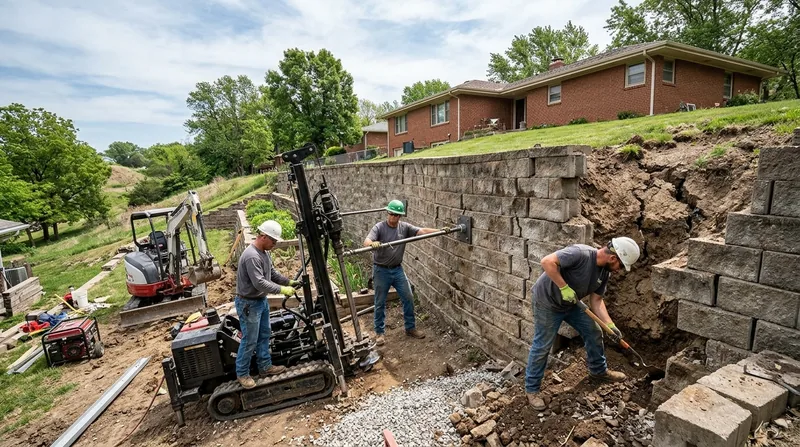




Retaining Wall Repair in Omaha: Stop the Lean Before It Falls
Omaha sits on wind-blown loess hills above the Missouri River, and that geology drives most of the wall failures we see. From the steep bluffs near Florence to the flat postwar blocks in Millard and Benson, saturated loess slumps, clay till swells, and hard freeze-thaw cycles pry walls apart. If your wall is leaning, bowing, or showing cracked mortar, Retaining Wall Repair in Omaha is the call that keeps a $1,500 fix from becoming a $15,000 rebuild. We diagnose the actual failure mode (drainage, footing, soil pressure, or frost heave) before we touch a single block. For walls that have already gone past repair, see our retaining wall replacement service.
Why Retaining Walls Fail in Omaha's Loess Hills and Clay Soils
Omaha's soil profile is the problem. Loess is wind-deposited silt that holds a vertical face when dry and turns to mush when saturated, and the clay till beneath it swells and shrinks with every wet-dry cycle. Add roughly 30 inches of annual precipitation, heavy spring thunderstorms, and repeated freeze-thaw, and you get the failure modes we repair every week.
- Walls lean or bow because hydrostatic pressure builds behind them when drainage is clogged or missing.
- Mortar joints crack and block courses separate as clay till swells and pushes the wall forward.
- Frost heave lifts and rotates footings during hard freeze-thaw cycles in January and February.
- Timber and railroad tie walls rot at the soil line and bulge under load after 15 to 25 years.
- Settlement cracks open where a wall crosses fill soil or an old utility trench.
Every one of these has a repair path, but the window closes fast once a wall passes 2 to 3 degrees of lean.
Key info: A segmental block wall in Dundee that leans 1 inch per foot is still repairable with drainage correction and tieback anchors. At 2 inches per foot, we are usually talking partial rebuild. The difference is measured, not guessed.
For the official rules on wall height and permits, check the City of Omaha Planning Department before you schedule work.
How We Diagnose and Repair a Failing Wall in Omaha
We do not quote a repair from the curb. A wall that looks like a drainage problem from the street is often a footing problem once we dig a test pit. Here is the sequence we run on every Omaha repair, from a Field Club garden wall to a west-side subdivision tier wall behind a walkout basement.
- We walk the wall, measure lean and bow with a level and string line, and photograph every crack.
- We dig a test pit at the base to expose the footing and check for frost damage and soil bearing.
- We inspect the drainage system, weep holes, and backfill to find where water is trapped.
- We identify the failure mode: hydrostatic pressure, footing settlement, frost heave, or rot.
- We recommend the least invasive repair that solves the actual cause, not just the symptom.
- We rebuild, anchor, or re-drain the wall and restore the grade and surface behind it.
You get a written scope and a fixed price before we start, and we do not open a wall until you approve it.
Key info: In a Papillion walkout lot, we found a 4-foot segmental wall bowing 3 inches. The cause was a clogged drain behind the wall and a downspout dumping at the top of the slope. We cleared and re-laid the drain, added a tieback anchor, and reset the top two courses for a fraction of a rebuild.
If the wall has already lost a section, go straight to our leaning and collapsed wall repair page so we can shore it up fast.
Repair Methods We Use on Omaha Walls
Not every wall needs the same fix. The method follows the failure mode, the wall material, and how much load the wall is carrying. Here is how we match the approach to the job.
| Approach | Description | Best for |
|---|---|---|
| Drainage correction | Clear or install footing drains, weep holes, and gravel backfill to relieve hydrostatic pressure. | Walls that lean or weep after heavy rain, common in loess yards. |
| Tieback anchors | Helical or grouted anchors driven into stable soil and connected to the wall face to pull it back. | Bowing block or concrete walls with sound footing and limited access. |
| Partial rebuild | Remove and reset the failed courses, rebuild the footing, and reinstall drainage. | Walls with cracked or displaced sections but a stable base. |
| Timber and tie replacement | Replace rotted timber or railroad tie courses with segmental block or new treated timber. | Aging tie walls in Benson, Ralston, and older midtown lots. |
| Crack injection and mortar repair | Inject structural epoxy or repoint mortar to seal cracks and restore continuity. | Poured concrete and CMU walls with settlement cracks. |
We tell you which method fits and which ones are a waste of money on your specific wall.
Retaining Wall Repair Cost in Omaha: What to Expect
Most retaining wall repairs in Omaha start at $1,500, and that figure covers a real repair, not a patch. A drainage correction with new weep holes and gravel backfill on a 20-foot wall typically lands in that range. Tieback anchors, partial rebuilds, and footing repairs push the number up because they involve excavation, new material, and more labor.
Four things move the price most: wall height and length, access for equipment (a wall behind a Dundee Victorian is tighter than a west-side subdivision lot), the failure mode (drainage is cheaper than footing), and whether the wall carries a surcharge like a driveway or structure above it. We always recommend two or three written estimates so you can compare scope, not just the bottom line. Our full pricing overview breaks down the ranges by repair type.
Retaining Wall Repair Near Me: How to Vet a Contractor Near Omaha
When you search for retaining wall repair near me, you get a long list of names and very little proof. Here is what actually matters before you sign anything, whether the wall is in La Vista, Bennington, or Blair.
- Confirm the contractor is fully insured, and ask for a certificate of insurance before work starts.
- Get two or three written estimates that describe the repair method, not just a lump sum.
- Ask for local references on walls of similar material and height, and call them.
- Ask who pulls the permit if your wall is over roughly 4 feet or supports a surcharge, and verify with the local building department.
- Check HOA rules on wall height, material, and setback before any rebuild begins.
A contractor who cannot explain the failure mode in plain language is guessing, and guessing on a retaining wall gets expensive.
Ready to stop the lean? Contact us for a free estimate and we will tell you what the wall needs and what it will cost.
Retaining Wall Repair in Omaha: Pricing Guide
| Service | Price | Details |
|---|---|---|
| Drainage correction and weep hole repair | Starting at $1,500 | Includes clearing or installing footing drains and gravel backfill on a typical 20-foot wall. |
| Tieback anchor installation | Starting at $2,800 | Includes helical anchors and face plates; price rises with wall height and access difficulty. |
| Partial rebuild of failed section | Starting at $3,500 | Includes removing and resetting courses, rebuilding footing, and reinstalling drainage behind the wall. |
| Timber or railroad tie wall repair | Starting at $2,200 | Includes replacing rotted courses; full material upgrade to block is quoted separately. |
| Complex or large-scale repair | On estimate | Tiered walls, surcharge loads, and footing failures need an on-site look before pricing. |
| Estimate | Free | Response within 24 hours at (402) 281-9526, no obligation to book the repair. |
Indicative pricing, the exact cost depends on square footage, finish, and site access. Free personalized estimate within 24h at (402) 281-9526.


