Why Omaha's Soil and Winters Demand the Right Retaining Wall Material
If you live in Omaha, you already know that our weather does not go easy on outdoor structures. The region sits on deep deposits of loess, a fine-grained, wind-blown silt that is notorious for shifting when it gets wet and expanding when it freezes. Combine that with winters that cycle through freeze-thaw dozens of times each season, and you have a recipe for wall failure if the wrong material is used. A retaining wall here is not just a decorative border; it is a structural system that has to hold back soil, manage water, and survive constant movement.
Many homeowners learn this the hard way after a few seasons. A wall that looked fine in July can start leaning, cracking, or bulging by the following spring. That is why material selection is the single most important decision you will make before any excavation begins. The right material, paired with proper drainage and base preparation, will hold for decades. The wrong one will cost you far more in repairs than it ever saved on installation. At Omaha Retaining Wall, we help homeowners sort through these choices every week, and the differences are worth understanding before you commit.
Concrete Retaining Walls: The Heavy-Duty Choice for Loess Soil
Concrete Retaining Walls are the most robust option available, and they are especially well suited to the challenges of loess. Poured concrete is rigid, dense, and resistant to the settling that plagues lighter materials. Because it is formed on site, it can be engineered to handle significant soil pressure, which matters on sloped lots where the wall has to hold back a substantial volume of earth. For tall walls or walls supporting a driveway or structure, concrete is often the only sensible choice.
The trade-off is cost and appearance. Concrete walls typically carry a higher upfront price than block or boulder options, and the plain gray finish is not for everyone. Many homeowners address this with a textured finish, stain, or veneer, which adds cost but delivers a high-end look. It is also worth noting that concrete performs best when it includes proper control joints and a well-designed drainage system. Without those, even a strong concrete wall can crack under freeze-thaw pressure. If you are considering this route, it is worth getting a professional assessment of your site before you budget, and our team can walk you through pricing based on your specific slope and soil conditions.
Block and Segmental Retaining Walls: Flexibility That Handles Freeze-Thaw
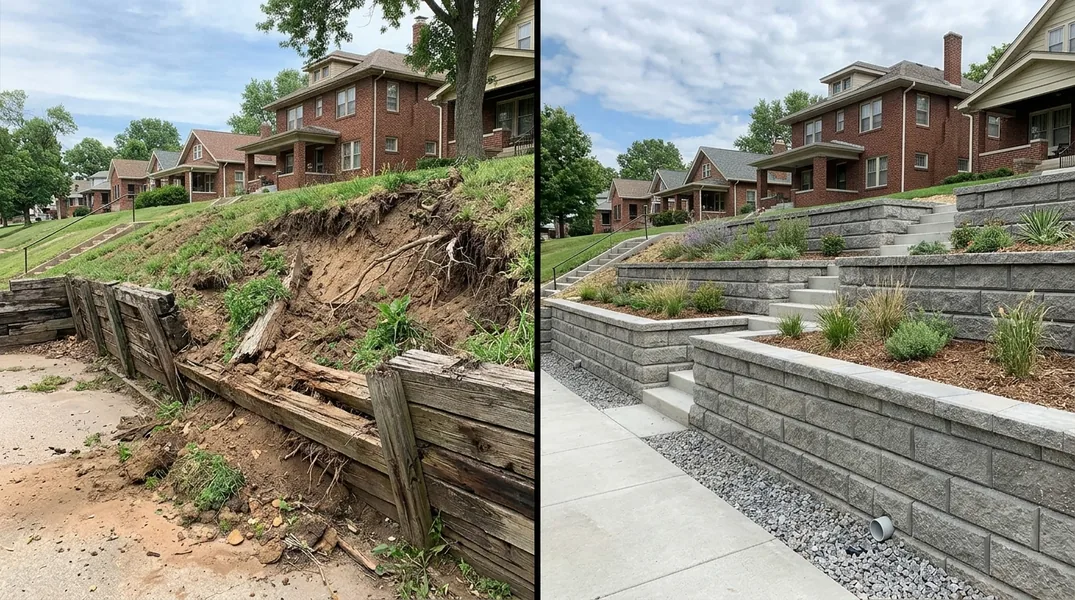
A Retaining Wall Installation using block or segmental systems has become the most popular choice for residential projects in the area, and for good reason. Segmental retaining walls are built from interlocking concrete units that flex slightly with ground movement instead of cracking. That flexibility is a major advantage in a climate where the ground heaves and settles repeatedly. Each block is engineered to lock into the next, creating a system that distributes pressure across the entire wall rather than concentrating it in one spot.
Block walls also offer the widest range of aesthetic options. You can choose from dozens of colors, textures, and profiles, from a clean modern look to a rustic stacked-stone appearance. Many systems are designed for mortarless construction, which speeds installation and reduces long-term maintenance. The key is proper base compaction and backfill drainage, since even the best block will fail if water is allowed to pool behind it. For homeowners comparing a Retaining Wall Repair against a full replacement, segmental systems are often the more cost-effective long-term path when an older wall has reached the end of its life. We regularly install these systems in Papillion and surrounding communities, and they hold up well through our seasonal swings.
Boulder Retaining Walls: Natural Character for Sloped Lots
Boulder retaining walls bring a natural, landscape-friendly look that many homeowners love, particularly on properties with existing rock features or mature plantings. Large boulders are set into the slope and stacked to create a wall that feels like it belongs on the site. Because each boulder is massive, the wall is extremely stable and resistant to the movement that lighter materials experience. They also drain well by nature, since water moves freely through the gaps between stones.
There are practical limits, though. Boulder walls work best on shorter slopes and are not ideal for tall retaining situations or where a perfectly straight, formal line is desired. Installation requires heavy equipment and skilled placement, so labor can run higher than a block wall of similar height. Sourcing quality boulders is another consideration, since not every quarry produces stone suited to structural placement. When done well, a boulder wall can last for generations and requires almost no maintenance. If you are in La Vista or a nearby neighborhood with rolling terrain, a boulder wall may be the most natural fit for your yard.
Retaining Wall Installation Near Me: Matching Material to Your Site
There is no single best material for every property. The right choice depends on wall height, soil conditions, drainage, budget, and the look you want. A short garden wall on a gentle slope may be perfectly served by a segmental block system, while a tall wall holding back a steep loess slope near a foundation calls for engineered concrete. Boulder walls shine on naturalized landscapes, and block walls offer the best balance of cost, flexibility, and appearance for most residential projects. A reputable contractor will evaluate your site rather than push a single product.
If you are searching for retaining wall installation near me, start by asking how the contractor handles drainage and base preparation, since those details matter more than the material label on the brochure. Ask for local references and examples of walls that have survived several winters. If your existing wall is showing cracks, leaning, or settling, a Retaining Wall Replacement may be more economical than repeated fixes. Homeowners in Ralston and across the metro can reach our team at (402) 281-9526 to talk through options, or request a free estimate and get a clear recommendation for your specific lot.
Retaining Wall Installation Cost in Omaha: What to Budget
Homeowners often ask what a retaining wall will cost before they have settled on a material, and the honest answer is that the range is wide. A simple block wall a couple of feet tall might start in the low thousands, while an engineered concrete wall holding back a steep slope can run well into five figures. Material, wall height, access to the site, soil conditions, and drainage requirements all move the number. Loess soil can require deeper footings and more extensive backfill than homeowners expect, and that is a cost worth planning for rather than cutting.
The best way to get an accurate figure is to have your site evaluated in person. A contractor who quotes a price over the phone without seeing the slope is guessing. During an on-site visit, we measure the wall, check soil and drainage, and discuss material options so you can compare real numbers. We are happy to provide a detailed, no-pressure free estimate for your project. Call Omaha Retaining Wall at (402) 281-9526 to schedule a visit and protect your property with a wall built for Omaha's soil and seasons.
Looking for a professional retaining wall contractor in Omaha? Omaha Retaining Wall responds fast for all your retaining wall needs.
Get a Free QuoteOur services: Retaining Wall Installation · Retaining Wall Repair · Retaining Wall Replacement